

 Posted: October 21, 2026
2027 is the year a large share of Ireland’s infrastructure pipeline moves from approval to site. The 2025 review of the National Development Plan committed €275.4bn to infrastructure between 2026 and 2035. Budget 2027 then set capital spending at €20.3bn for next year.
Funding is no longer the main constraint. People are. Property Industry Ireland estimates the construction sector needs between 95,000 and 110,000 additional workers by 2030, on top of the 177,600 it employs today.
This guide ranks the biggest construction projects in Ireland for 2027 by the measure that matters if you work in the industry: how many engineers, managers and site staff each one will need. If you are planning your next move, this is where the work will be.
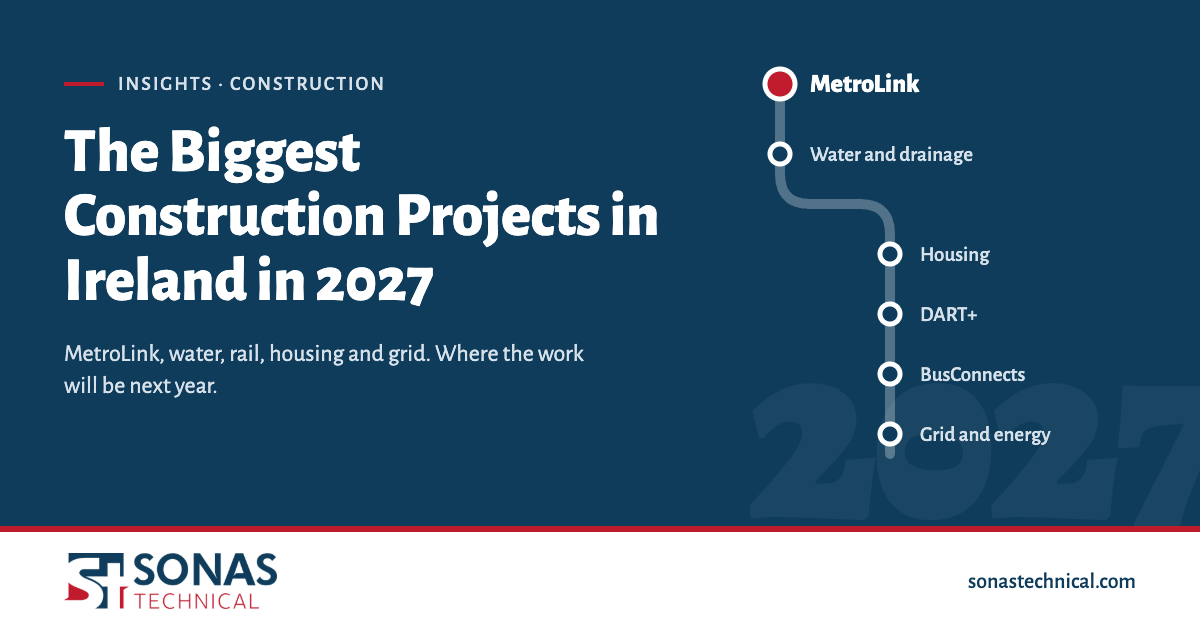
1. MetroLink, Dublin: Ireland’s largest construction project
MetroLink is the biggest construction project in Ireland in 2027 by a distance. It is an 18.8km, largely underground automated metro with 16 stations, running from Estuary in Swords through Dublin Airport, Ballymun and Glasnevin to Charlemont in the south city.
In September 2026 the Government approved a budget of up to €17.5bn and moved the project into its detailed tender stage. Advance and enabling works are expected on the ground from early 2027, with the main tunnelling and station packages following.
The work is split into three packages. M401, the southern civil works contract, is valued at about €4.6bn with award targeted for Q3 2027. M402, the northern civil works contract, is about €3.3bn with award targeted for Q4 2027. M500 covers rail systems, rolling stock, operations and maintenance at about €7.3bn, with financial close expected in Q4 2028. Construction is expected to take eight to ten years.
Who MetroLink will need in 2027
Hiring comes in waves. Bid teams need estimators, planners, tender quantity surveyors, design managers and temporary works engineers now. Once the civils contracts are awarded, demand shifts to section engineers, site managers, utilities coordinators, tunnelling engineers, survey and monitoring teams and health and safety staff. Rail systems, signalling and commissioning roles build from 2028.
Our complete guide to MetroLink covers the route, contracts and timeline in detail.
Sonas perspective: The consortia bidding for M401 and M402 are naming key personnel in their submissions now. If you have deep excavation, tunnelling or urban utilities experience, the conversation about your MetroLink role is happening this winter, not after contract award.
2. Uisce Éireann’s water and wastewater megaprojects
Two Uisce Éireann projects will together represent over €7bn of investment in water infrastructure. Both are about housing. Without them, large parts of the Greater Dublin Area cannot be built out.
Greater Dublin Drainage
The Greater Dublin Drainage project will provide wastewater treatment for the equivalent of about 500,000 people and support up to 185,000 new homes across north Dublin, Meath and Kildare. It includes a 14km orbital sewer and an 11km outfall pipeline into the sea off north county Dublin.
Preliminary works are scheduled to start by the end of 2026, with main works from 2028 and completion targeted for 2031. Procurement for the main works contracts, including the orbital sewer and the land and marine outfall pipeline, launched in 2026.
Water Supply Project, Eastern and Midlands Region
The Water Supply Project is the largest water scheme in the history of the State. It would draw water from the Shannon at Parteen Basin, treat it at a new plant near Birdhill and pump it through a 170km pipeline across Tipperary, Offaly and Kildare to a reservoir at Peamount in County Dublin. The estimated cost is €4.6bn to €5.9bn.
An Coimisiún Pleanála intends to decide on the application before 02/07/2027. Uisce Éireann is running procurement in parallel so it can move straight to delivery, with construction targeted for 2028 and up to 1,000 people on the project at peak.
For candidates, 2027 is when contractors on both projects form their teams. Pipeline engineers, MEICA engineers, marine and tunnelling specialists, environmental advisors and land and CPO specialists will be in demand.
3. Housing delivery and the Land Development Agency
Housing is the largest source of construction employment in Ireland, even if no single scheme matches MetroLink for scale. The Land Development Agency is now one of the biggest players.
The LDA has more than 6,500 homes under construction on over 20 sites and a pipeline of more than 28,000 homes. It expects to complete nearly 3,000 homes in 2027 and more than 3,500 in 2028, which would make it one of the largest home producers in the State. Major sites include Clongriffin and Baldoyle in north Dublin.
Housing demand is spread across many sites, which means steady, local work rather than one large mobilisation. Site managers, project managers, MEP engineers, quantity surveyors and people with modern methods of construction experience will have strong options in 2027.
4. DART+ West and DART+ South West
The DART+ programme will expand Dublin’s electrified rail network. DART+ West is first. It covers electrification of the Maynooth and M3 Parkway lines, a new DART depot west of Maynooth, a new station at Spencer Dock and capacity works at Connolly.
The Minister for Transport told the Dáil in April 2026 that he expects construction on DART+ West to start in 2027. DART+ South West, which includes four-tracking between Park West and Heuston and a new Heuston West station, could follow in 2028. Framework contracts set up for DART+ West will also be used on South West.
Rail civils engineers, overhead line electrification specialists, signalling engineers and possession planners are the roles to watch.
5. BusConnects Dublin core bus corridors
BusConnects is less visible than MetroLink but it is a large, multi-year civils programme. The 12 Core Bus Corridor schemes will deliver about 230km of bus lanes and 200km of cycle tracks across five local authority areas. All 12 have planning approval.
The Liffey Valley to City Centre corridor, with an estimated cost of up to €274m, and the Ballymun/Finglas to City Centre corridor are under way. The remaining corridors will move to construction under the NTA’s framework over the coming years.
This is utilities-heavy urban work. Civil and road engineers, setting out engineers, utilities coordinators, traffic management specialists and community liaison staff will all be needed.
6. Electricity grid and offshore energy
EirGrid and ESB Networks have an investment package of up to €18.9bn for 2026 to 2030. That money funds substations, overhead lines and underground cables across the country, and it competes with transport projects for the same civil and electrical engineers.
The Celtic Interconnector, a 575km, 700MW high-voltage link between Cork and France, is in its final stages, with the converter station at Ballyadam and the substation at Gogganstown under construction. In Wexford, Rosslare Europort plans a €220m offshore renewable energy hub. Subject to planning and funding, construction would begin in early 2027 and finish in early 2029.
Sonas perspective: Grid work rarely makes headlines, but it draws on the same pool of electrical, commissioning and civils talent as MetroLink and DART+. Candidates with HV substation or cable experience will have more choice in 2027 than in any year we have seen. Employers will need to move quickly to secure them.
Other major projects to watch in 2027
Several large projects will not be in full construction in 2027 but will create design, consultancy and pre-construction roles.
N/M20 Cork to Limerick motorway
The €1.2bn N/M20 will deliver about 80km of new and improved road between Cork and Patrickswell. A planning application is expected, and construction could begin in 2028, starting with bypasses of Charleville, Buttevant and Mallow. It is the largest infrastructure project outside Dublin.
Luas Finglas
Luas Finglas received planning approval in October 2025. The 3.9km extension of the Green Line to Charlestown is estimated at €600m, with completion targeted for 2031.
Cork Area Commuter Rail Phase 2
Phase 2 includes six new stations, electrification of the Cork network and a new depot. A Railway Order application is expected by the end of 2026.
National Maternity Hospital at St Vincent’s
The new National Maternity Hospital will be a seven-storey, 244-bed building of more than 50,000 square metres. The HSE reported in August 2026 that work to prepare for construction is ongoing.
What this means for your career in 2027
The demand is concentrated in the Greater Dublin Area. MetroLink, Greater Dublin Drainage, DART+ and BusConnects all sit within commuting distance of each other and all need civils, utilities and site management staff at the same time.
Bid and pre-construction roles come first. If you want a senior position on a major project, the time to position yourself is before contract award, when contractors are building their teams and naming key people.
Specialist skills carry the most leverage. Tunnelling, deep excavation, rail systems, HV electrical and MEICA experience are scarce in Ireland. People with those skills, including Irish engineers working abroad, are in a strong position to negotiate. Our 2026 Salary and Benefits Guide shows current rates by role.
Contract work will grow too. Large programmes rely heavily on contract engineers and specialists through peak phases. Read more about working as a contractor with Sonas.
Frequently asked questions
What is the biggest construction project in Ireland in 2027?
MetroLink in Dublin. The Government approved a budget of up to €17.5bn in September 2026, and the two main civil works contracts are due for award in 2027.
When does MetroLink construction start?
Advance and enabling works are expected from early 2027. The M401 contract is targeted for award in Q3 2027 and M402 in Q4 2027, with main construction following.
Which construction jobs will be most in demand in Ireland in 2027?
Site and section engineers, site managers, quantity surveyors, planners, tunnelling engineers, utilities coordinators, HV electrical engineers and MEICA engineers. Bid-stage roles such as estimators and design managers are in demand now.
How many construction workers does Ireland need?
Property Industry Ireland estimates the sector needs 95,000 to 110,000 additional workers by 2030 to deliver the planned housing and infrastructure pipeline.
Find your next role on Ireland’s biggest projects
Sonas Technical recruits engineering, construction and technical professionals for the contractors, consultancies and public bodies delivering these projects. We work across permanent and contract roles.
Browse our current construction and engineering jobs or register your CV and we will contact you as roles on these projects open.